

Showing 61 - 80 of 89 results
Space research enabled with new capability
New high energy ion microprobe beamline supports space research on the effects of radiation on astronauts.
An accurate and inexpensive test for Malaria just around the corner
International science team paves way for fast and accurate flu diagnosis

Senior Principal Research and Neutron Scattering Instrument Scientist
Role at ANSTO
- Leader, Energy Materials Research Project
Insights into Titan’s atmosphere
Terahertz/Far Infrared beamlines assisted investigation into possible composition of lower atmosphere of Saturn's moon Titan.
Sharing expertise with regional neighbours
Participants undertook IAEA training hosted by Macquarie University and ANSTO on use of radionuclides for soil and water investigations.

Principal Scientist and Biology Group Leader
Role at ANSTO
Symposium on advanced therapy
Science and medical experts meet in Adelaide to discuss great potential of particle therapy in Australia

Emu - High-Resolution Backscattering Spectrometer
Theinstrument is typically used to study diffusing water molecules or yet larger molecules like polymers or biological molecules. In addition, Emu can reveal quantum-mechanical tunnelling.
Crystallography out of this world
ANSTO technology and expertise heading to Antarctica for atmosphere studies
Innovative technology provides enhancement to advanced radiation therapy
Neutron Capture Enhanced Particle Therapy developed at ANSTO.

Australian access to overseas synchrotrons
The International Synchrotron Access Program (ISAP) is administered by the Australian Synchrotron and is designed to assist Australian-based synchrotron users to access overseas synchrotron related facilities.
Publications
Publications and resources from the Powder Diffraction beamline.
Through the looking glass: the strange atomic structure of glassy materials
The mechanical, electrical, chemical, optical and thermal properties of glass, as determined by its chemical composition and atomic structure, make it a highly useful material with a myriad of applications.
Micro-Computed Tomography beamline (MCT)
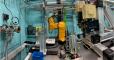
With enhanced submicron spatial resolution, speed and contrast, the Micro-Computed Tomography beamline opens a window on the micron-scale 3D structure of a wide range of samples relevant to many areas of science including life sciences, materials engineering, anthropology, palaeontology and geology. MCT will be able to undertake high-speed and high-throughput studies, as well as provide a range of phase-contrast imaging modalities.
Air pollution sampler installation in Papua New Guinea
Building knowledge of changes in uranium chemistry
A new systematic investigation of the origins of atomic structural distortions in compounds containing uranium has relevance for spent nuclear fuel .

Head of Radiochemistry
Role at ANSTO