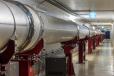
Advancing particle therapy
Meeting of minds about potential next-generation cancer treatment for Australians
Showing 621 - 640 of 648 results
Meeting of minds about potential next-generation cancer treatment for Australians
Information has been provided to assist with the preparation of experiment proposals and beamtime.
The nuclear analysis team at ANSTO recently had a significant role in the re-design and optimisation of a cold neutron source facility for the reactor, its installation and the subsequent restart after a six-month shutdown.
Four annual awards in neutron scattering were announced at Australian Neutron Beam Users Group (ANBUG) and AINSE Neutron Scattering Symposium (AANSS) to individuals with strong links to ANSTO
ANSTO has supported a new study published in Quaternary Science Reviews that dates the dramatic collapse of one of the largest glaciers ever documented in the Himalayas. The findings overturn a long-held assumption about what sustains wet-climate glaciers.
Principal Research Scientist Andrew Smith is travelling to the Taylor Glacier in Antarctica with American collaborators on a 3-year National Science Foundation project now in its final year that involves mining tonnes of ice for palaeoclimate research.
ANSTO provides eduroam services for partnering institutions in Australia and around the world.
Pioneering work on materials for energy production, such as lithium ion batteries, has made ANSTO a centre of specialist capabilities and expertise.
Frequently Asked Questions on the Macromolecular Crystallography beamlines (MX1 and MX2)
On the 10th of October 2025, the Minister for Industry, Science and Technology provided his Statement of Expectations to ANSTO.
Using the past to illuminate the future: Brothers collaborate on important science documentary for ABC TV
Technical information on the SAXS / WAXS beamline at the Australian Synchrotron.
The User Advisory Committee (UAC) are pleased to present this year's invited speakers.
The Infrared microspectroscopy microscopes can record spectra from a range of different samples; from thin microtomed sections to polished blocks and embedded particles. This section highlights the types of samples that can be analysed using the IRM beamline
Highlights of the Energy Materials Project.