Services - Taipan
Sample environments, Data analysis, SpICE and SICS


Showing 101 - 120 of 183 results
Sample environments, Data analysis, SpICE and SICS

The BRIGHT Nanoprobe beamline provides a unique facility capable of spectroscopic and full-field imaging. NANO will undertake high-resolution elemental mapping and ptychographic coherent diffraction imaging. Elemental mapping and XANES studies (after DCM upgrade) will be possible at sub-100 nm resolution, with structural features able to be studied down to 15 nm using ptychography.

Career Statement and Role at ANSTO
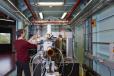
Beamtime Guide on the X-ray Fluorescence Microscopy beamline at the Australian Synchrotron.

The Macromolecular Crystallography beamlines at the Australian Synchrotron (MX1 and MX2) are general purpose crystallography instruments for determining chemical and biological structures.


Dr Santosh Panjikar is a beamline scientist at the MX beamlines of the ANSTO, Australian Synchrotron. A large part of his scientific role involves assisting scientists from the crystallography user commun

You are invited to submit to the various awards from ANSTO, User Advisory Committee (UAC) and Australian Neutron Beam User Group (ANBUG).

Radiation can be described as energy or particles from a source that travel through space or other mediums. Light, heat, and wireless communications are all forms of radiation.


A world-class national research facility that uses accelerator technology to produce a powerful source of light-X rays and infrared radiation a million times brighter than the sun.

Role at ANSTO



Explore ANSTO's range of publications and reports available for the public.
Historic memorandums of understanding on the peaceful use of nuclear with Thailand and Canada.

ANSTO is proud to host the Shorebirds Competition for the fifth year. This unique environmental poster competition is free to enter and offers over $4500 in prizes for students and schools!