
User Meeting 2024 award recipients
ANSTO and the User Meeting 2024 organising committee celebrate this years award recipients.


Showing 101 - 120 of 477 results
ANSTO and the User Meeting 2024 organising committee celebrate this years award recipients.
ANSTO, the home of Australia’s nuclear science expertise and the Powerhouse Museum, home of Australia’s excellence and innovation in the applied arts and sciences will collaborate on research projects, establish an Indigenous Cultural Research Scholarship and combine efforts on STEM outreach activities.
Recognition of research that developed a life-saving pharmaceutical milkshake using synchrotron techniques.

Ultra-flexible electronics has many potential applications within areas such as for example the military, healthcare and energy.
Thales Australia, a key supplier to the Australian Defence Forces, provided an industrial challenge to National Graduate Innovation Forum participants relating to the production of piezoelectric ceramic components used in naval sonar arrays and systems.
Investigators from UNSW and ANSTO have provided insights into the dynamic interactions of atoms in a promising material for sodium-ion batteries.
ANSTO researchers have demonstrated longstanding expertise in the study of nuclear fuel and radioactive waste with two recent journal articles in a special issue of Frontiers of Chemistry.
New class of conducting materials found for potential use in next generation fuel cells and other applications.
Project Bright, the construction of eight new beamlines at ANSTO’s Australian Synchrotron has reached a milestone by achieving ‘First Light’ for the new micro-computed tomography (MCT) beamline in late NovembeR.

The project aims to engage the wider cultural heritage community in addition to our internal research.
Paper on redefinition of the kilogram receives international award
Thirty years of ANSTO's unique capability in monitoring fine particle pollution provides insight on bushfire smoke.
Development of new techniques makes it possible to date Australian Aboriginal rock art.
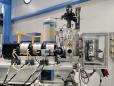
The high-energy heavy-ion microprobe is used for the characterisation or modification of material properties at depths from approximately 1 micrometre to maximum depths of up to 500 micrometres from the material surface.
Advanced X-ray techniques have revealed new structural details about the specific arrangement of atoms in conjugated polymers, an important class of materials that are used in LEDs, organic solar cells, transistors, sensors and thermoelectric power devices.
Study shows for the first time that vegetation in the Windmill Islands, East Antarctica is changing rapidly in response to a drying climate.
More than 3,200 solar panels have been installed across the rooftops of the Australian Nuclear Science and Technology Organisation’s (ANSTO) Australian Synchrotron in Clayton, offsetting enough power to light up the whole MCG for more than five years.