

Showing 1141 - 1160 of 2448 results
Opportunity to spend a year in industry for STEM undergraduates

Radon
The Radon Analytical Laboratory operates a comprehensive suite of instrumentation for the monitoring and analysis of natural radioactivity resulting from radon, thoron and their progeny.
Women's fertility linked to detox element selenium in diet
Advanced nuclear waste forms
Australian science teachers off to CERN
After careful selection, three Australian science teachers are set to fly to Geneva today after winning positions on the International High School Teacher Programme at CERN.

Understanding the full impact of radiation on astronauts
In collaboration with the French National Institute of Health and Medical Research (INSERM) and the French International Space Agency (CNES), ANSTO scientists are undertaking research on the radiobiological effects of secondary particles that are created when radiation interacts with the shielding on the International Space Station.
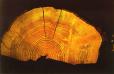
Radiocarbon dating
Radiocarbon dating is a well-known method for determining the age of materials up to the age of approximately 50,000 years.
nandin unlocks 400 years of business expertise
New mentor program offers deep brains trust to support the development of southern Sydney startups
ANSTO Chair Announcement - Reappointment of ANSTO CEO
The Chair of ANSTO, The Hon Dr Annabelle Bennett, AC SC, announced today that Mr Shaun Jenkinson has been reappointed as the Chief Executive Officer of ANSTO.
Using ocean water to understand feeding habits of Humpback Whales

Understanding organic solar cells
The design and implementation of alternative energy sources is one of the greatest scientific and social challenges of our time.

Project BRIGHT
The BRIGHT Project will expand the beamline infrastructure of the Australian Synchrotron to increase both its capacity and capabilities.
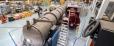
Industry Access - Lucas Heights
ANSTO’s Lucas Heights campus has an extensive range of specialised facilities and capabilities that are available to assist industry-based professionals in solving problems. Please contact us to discuss how we can assist you. We are open to entering into commercial arrangement with appropriate partners.
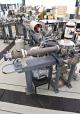
Proton Elastic Scattering
Proton Elastic Scattering (PESA) is ideally suited to the measurement of hydrogen concentration in thin samples.
New Electron Microscopy Facility opened
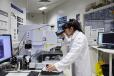
Infrared microspectroscopy
The Infrared Microspectroscopy beamline combines the high brilliance and collimation of the synchrotron beam through a Bruker V80v Fourier Transform Infrared (FTIR) spectrometer and into a Hyperion 3000 IR microscope to reach high signal-to-noise ratios at diffraction limited spatial resolutions between 3-8 μm.
Connecting bright STEM graduates with industries drives innovation
ANSTO, Australia’s knowledge centre for nuclear science and technology, connects STEM graduates with industry to work on real-world challenges through its FutureNow Scholarships for 2022.
Innovative radioactive waste treatment technology forging ahead
International interest is building in Australia’s new multi-million-dollar radioactive waste processing facility at the Sydney campus of the Australian Nuclear Science and Technology Organisation (ANSTO).
Advancing particle therapy
Meeting of minds about potential next-generation cancer treatment for Australians