Search hero banner

Search results

Showing 121 - 140 of 300 results

Big Ideas forum 2020

Big Ideas

ANSTO Big Ideas encourages students to creatively communicate the work of an Australian scientist, and explain how their work has inspired them to come up with a Big Idea to make our world a better place. This competition is intended to engage and support Australian students in years 7-10 in Science and encourage them to pursue studies and careers in STEM.

Graphene superconductor

Superconducting calcium-injected graphene

Since the discovery of superconducting Caintercalated graphite (CaC6) the intercalation of epitaxial graphene on SiC(0001) with Ca has been studied extensively in order to achieve superconductivity.

2025 Deaf Youth Science Camp

Deaf Youth Science Camp 2026

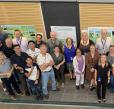
Deaf Youth Science Camp is back for 2026! Deaf Youth Science Camp (DYSC) is a fun 4-day immersive science experience for Deaf/hard-of-hearing young people (aged 12-17 years old). Held at ANSTO at Lucas Heights, Sydney, the camp is a mix of hands-on science activities, outdoor activities and excursions to nearby science centres. Participants will work with Deaf professionals to learn about careers in STEM, develop personal and leadership skills and meet new friends. This camp is hosted by Deaf Youth Australia and ANSTO, and funded by a National Science Week grant.

generic-background-image

Online learning

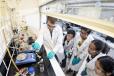
Discover the amazing world of nuclear science from your classroom. Join us for Meet an Expert, Nuclear Science Inquiry Skills, Junior Science, and Online Depth Study sessions for Chemistry, Physics and Investigating Science.

Grant Success

Both the Australian Centre for Neutron Scattering  and the National Deuteration Facility share in grants

'Towering' engineering victory

Building a stable tower out of paper and designing a bionic limb were among the challenges of the Discover Engineering day, held on 11 May at ANSTO.

Graphene

Scalable graphene growth on a semiconductor

The growth and incorporation of graphene into semiconductor device architectures has been limited by challenges related to the quality, reproducibility, and high process temperatures required to grow it on suitable substrates.

Pagination