Accelerator-based ion beam analysis (IBA) techniques and capabilities can be applied across a range of investigations.
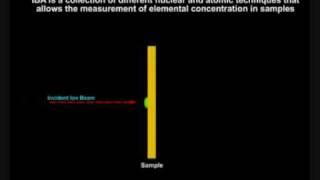
Some recent research includes monitoring ambient air pollution at sites across Australia and Asia known as the aerosol sampling program (ASP), determining heavy metal pollutants in biological systems, studying the composition of archaeological artifacts and soil specimens, analysing thin films for photovoltaic (solar cell) applications, and probing materials engineering problems such as corrosion and coating delamination.
Techniques
Click on the technique for more information
| Technique | Applications | Elements | Sensitivity | Depth resolution | Analysis depth |
| RBS | Surface and thin film composition and thickness. |
Li - U | Best for heavy elements on light element substrate (eg Cu on Si) typical 10% (Li) - 0.001% (U) |
5-20 nm | Up to 1 mm |
| PIXE | Trace element composition of particulates and bulk materials. |
Si-U | Opimum near Fe (1ppm) elemental sensitivities range from 1 - 100ppm |
Typical proton range 20- 50 microns |
Up to 1 mm |
| PIGE |
Trace element composition of particulates |
Li-Al |
Element dependent, typically |
up to 1 mm | |
| NRA | Isotopic tracing and profiling in materials, surfaces and interfaces. |
H-Si | Element dependent, typically in range 1 - 100 ppm |
5-20 nm | up to 1 mm |
| PESA | Hydrogen in polymers, polymer interdiffusion, hydrogen in solar cells. |
H, D | > 0.1% | 10-20 nm | up to 1 mm |
| ERDA & RToF | Elemental composition and structure of near surface regions. thin films. |
H-U | > 0.1 % | 10-20 nm | up to 1 mm |
| μERDA | Elemental mapping and depth profiling in materials science. |
>0.1 % | >50 nm | up to 20 μm | |
| μPIXE | Trace element mapping in biological, environmental and geological samples. |
Si-U | > 100 ppm | up to 3 μm | |
| IBIC | Charge collection mapping in electronic devices and detectors. |
up to 1 μm |
|
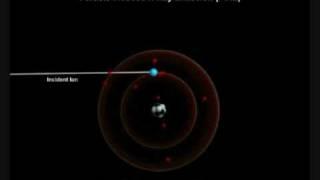 Particle Induced X-ray Emission (PIXE) |
 Rutherford Backscattering (RBS) |
|
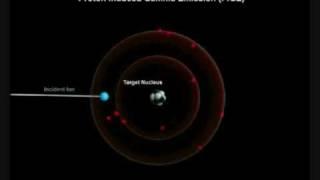 Particle Induced Gamma Emission (PIGE) |
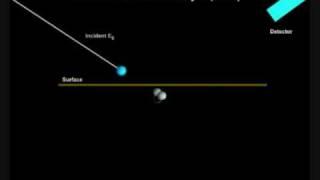 Elastic Recoil Detection (ERD & RToF |
Partners and collaborators
The IBA facilities are offered to 37 universities through AINSE and members of the group are involved in significant research projects that impact Australia and the wider global community. The IBA has partnerships with several environmental protection agencies, the Australian Coal Association, private industry, the CSIRO and International Atomic Energy Agency in Vienna (IAEA), among others.
Proposals
Australian and international researchers and industry can request access to IBA facilities through ANSTO's Research Portal for users.
Please discuss your proposal with the appropriate ANSTO contact scientist before submitting a proposal as they will assist you in making the correct capability selection.