Seeing into dinosaur bone
Australia’s best known carnivorous dinosaur Australovenator is under the microscope at ANSTO


Showing 221 - 240 of 676 results
Australia’s best known carnivorous dinosaur Australovenator is under the microscope at ANSTO

Participants undertook IAEA training hosted by Macquarie University and ANSTO on use of radionuclides for soil and water investigations.
Virtual activities celebrating the benefits of nuclear science and technology held for National Science Week
COVID-19 can’t stop kids with a passion for science and technology, with ANSTO launching our new online STEAM Club just in time for the school holidays.
In 2023 we’re celebrating the 70th Anniversary since Australia began developing our nation’s Australia’s nuclear capabilities.
New high energy ion microprobe beamline supports space research on the effects of radiation on astronauts.
ANSTO contributes to major study on global warming by measuring methane and carbon monoxide trapped in ice.

Dr. Qinfen Gu leads the Powder Diffraction beamline team at the Australian Synchrotron, ANSTO, and serves as an Honorary Principal Fellow in the Department of Chemical Engineering at the University of Melbourne.
ANSTO to contribute to research on Next Gen Nuclear Energy Systems

In space, without the protection of the magnetosphere, the type and dose of radiation is considerably different to what is naturally experienced on earth. However, it is the secondary particles of lower energies created when galactic and cosmic radiation interacts with shielding that is of concern for astronauts.

In collaboration with the French National Institute of Health and Medical Research (INSERM) and the French International Space Agency (CNES), ANSTO scientists are undertaking research on the radiobiological effects of secondary particles that are created when radiation interacts with the shielding on the International Space Station.
The first demonstration of reversible symmetry lowering phase transformation with heating.
The new Micro Computed Tomography (MCT) beamline is the first instrument to become operational as part of the $94 million Project BRIGHT program, which will see the completion of eight new beamlines at ANSTO’s Australian Synchrotron.
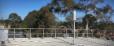
ANSTO continually monitors environmental gamma radiation from a station located in Engadine NSW. ANSTO uses environmental radiation data to evaluate atmospheric dispersion from its site. This radiation is almost completely natural background radiation.
ANSTO has contributed to a large international study which decodes a fundamental process in Earth’s history and provides guidelines regarding the types of research questions that palaeontologists can investigate using marine fossils.
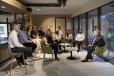
ANSTO's Graduate Program develops the next generation of Australian business and science leaders, by providing the best and brightest postgraduate students with a two-year rotation cycle, tailored to match your talents, goals and interests.
Grant supports development of handheld technology to verify origin of seafood.