Sharing expertise with Japan
The National Deuteration facility is assisting with the establishment of a Japanese Chemical Deuteration Facility.


Showing 381 - 400 of 442 results
The National Deuteration facility is assisting with the establishment of a Japanese Chemical Deuteration Facility.
Collaboration finds that old carbon reservoirs are unlikely to cause a massive greenhouse gas release in a warming world.
The mechanical, electrical, chemical, optical and thermal properties of glass, as determined by its chemical composition and atomic structure, make it a highly useful material with a myriad of applications.
ANSTO is part of collaboration conducting experiments to redefine the kilogram linking it to a fundamental constant of nature.
Radiocarbon dating capabilities at the Centre for Accelerator Science have provided evidence of a 17,300-year old painting of a kangaroo from the Kimberley region.
ANSTO is a partner on the National Space Qualification Network (NSQN) led by the Australian National University (ANU) that will transform Australia into a world-leading space centre by enhancing facilities to test payloads, components, and hardware prior to their use in harsh environments of space.
New technology is being developed in Sydney to recycle used Personal Protective Equipment (PPE) and turn it into raw materials for 3D printing.

Dr Meng Jun Qin is a materials scientist with expertise in computer modelling

ANSTO Publications Online is a digital repository for publications authored by ANSTO staff and collaborators since 1956.
A large collaboration of European investigators gained insights into how the SARS-CoV-2 spike protein (S protein) impacts with lipid metabolism in the body with implications for COVID-19 infection and mRNA vaccination.
Study reveals that properties of polycrystalline materials can be derived from microscopic single crystal samples
Research makes it possible to assess if and how rocky coasts, which make up the majority of the world’s coasts including Australia and New Zealand, will respond to changes in marine conditions.
Powerful combination of deuteration and neutron scattering used to characterise structure of molecules on surface of nanoparticles.
The need for a smaller, more transportable version of ANSTO’s 1500-litre atmospheric radon-222 monitor, and with a calibration traceable to the International System of Units, prompted the team to develop a 200-litre radon monitor that would meet those needs.

ANSTO’s Australian Synchrotron has been working on an initiative that could substantially improve radiotherapy treatment for cancer patients.
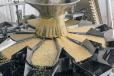
Understanding the molecular structure of ingredients can improve the qualities of food.
Research demonstrates the existence of hexagonal planar geometry in a transition metal complex with great potential application across multiple disciplines.
Dr Linda Croton, a Research Fellow at Monash University, has been awarded the 2020 ANSTO Australian Synchrotron Stephen Wilkins Thesis medal for her outstanding work using synchrotron-based X-ray for brain imaging.