Tritium & other LSC
Accurate low level tritiated water (HTO) data is an essential tool for groundwater dating and understanding groundwater recharge processes.


Showing 81 - 100 of 234 results
Accurate low level tritiated water (HTO) data is an essential tool for groundwater dating and understanding groundwater recharge processes.
The final report on the safety of Building 23 by the independent expert review team has been completed.

Read about an ANSTO scientist and their work to prepare for a school project or interview.

This scholarship recognises outstanding ability and promise in the field of nuclear science and technology, specifically as it applies to nuclear energy. Successful applicants will demonstrate a history of interest in nuclear energy and a desire to continue this interest.
nandin member, SVSR, report on their proof-of-concept for a reusable Graphene Oxide (GO) membrane to capture waste water vapours from ageing sewerage systems.
The need for a smaller, more transportable version of ANSTO’s 1500-litre atmospheric radon-222 monitor, and with a calibration traceable to the International System of Units, prompted the team to develop a 200-litre radon monitor that would meet those needs.

ANSTO is one of the world's leading providers of irradiation services for silicon ingots, which are used by the multimillion dollar electronics industry across Europe and Asia. Each year, ANSTO irradiates more than 50 tonnes of silicon.

Kathleen manages the quality and document management systems, and oversees procedures for inspection, testing, and calibration of equipment and systems, to support the accelerator operations and beam lines.

See details of previously published customer updates from our Health products team.
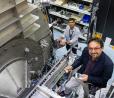
The QUOKKA instrument provides the powerful technique of small-angle neutron scattering which can look at sizes and structures of objects on the nanoscale including soft matter.
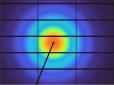
The Biological Small Angle X-ray Scattering beamline will be optimised for measuring small angle scattering of surfactants, nanoparticles, polymers, lipids, proteins and other biological macromolecules in solution. BioSAXS combines combine a state-of-the-art high-flux small angle scattering beamline with specialised in-line protein purification and preparation techniques for high-throughput protein analysis.

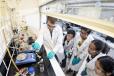
ANSTO Big Ideas encourages students to creatively communicate the work of an Australian scientist, and explain how their work has inspired them to come up with a Big Idea to make our world a better place. This competition is intended to engage and support Australian students in years 7-10 in Science and encourage them to pursue studies and careers in STEM.

CORIS360® GNI images gamma-ray and thermal neutron radiation sources, delivering an unprecedented ability to detect, localise, and identify nuclear materials.