
Year In Industry Internship Program
The ANSTO Year In Industry Internship Program is for penultimate year students studying towards relevant scientific and/or engineering degrees.


Showing 121 - 140 of 524 results
The ANSTO Year In Industry Internship Program is for penultimate year students studying towards relevant scientific and/or engineering degrees.
ANSTO is helping change the way science is taught in the classroom - converting that dusty old periodic table into an augmented reality app that brings the elements to life.
ANSTO participation in ARC on Intelligent Robotic Systems for Real-time Asset Management has potential benefit in the management of infrastructure and assets

ANSTO's Minerals team provides consultancy, process development and research services to the mining and minerals processing industries.

The Advanced Diffraction and Scattering beamlines (ADS-1 and ADS-2) are two independently operating, experimentally flexible beamlines that will use high-energy X-ray diffraction and imaging to characterise the structures of new materials and minerals.
New facility will greatly enhance Australia’s capability in stress engineering for industry
Neutron and gamma ghost imaging are important scientific developments reported in two publications, and the subject of an Australian Research Council Discovery Project grant awarded to a team that includes ANSTO scientists
Using the past to illuminate the future: Brothers collaborate on important science documentary for ABC TV

In partnership with the Australian Museum as part of National Science Week explore the 2020 hackathon theme of Deep Blue: Innovation for the future of our oceans
ANSTO has been granted a patent in Australia and a number of European countries for the separation, a key radioactive contaminant in critical minerals processing, actinium-227, from process liquors used in minerals extraction.

Challenge your understanding of nuclear science and technology with fun secondary school activities, exciting competitions and unique tours of our facilities.
Virtual activities celebrating the benefits of nuclear science and technology held for National Science Week
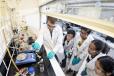
ANSTO Big Ideas encourages students to creatively communicate the work of an Australian scientist, and explain how their work has inspired them to come up with a Big Idea to make our world a better place. This competition is intended to engage and support Australian students in years 7-10 in Science and encourage them to pursue studies and careers in STEM.
Proposals to Australian Centre for Neutron Scattering and National Deuteration Facility closed

Frequently asked questions about the ANSTO Security Process, travel funding, ANSTO Research Portal and ACNS Customer Portal.
Atomic structure of new cathode material for sodium ion batteries helps explain long life