Federal grants for ANSTO expertise and infrastructure will benefit manufacturing and nuclear technologies
Three new federal grants were announced to support manufacturing and nuclear technologies.


Showing 861 - 880 of 1644 results
Three new federal grants were announced to support manufacturing and nuclear technologies.

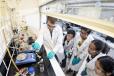
ANSTO Big Ideas encourages students to creatively communicate the work of an Australian scientist, and explain how their work has inspired them to come up with a Big Idea to make our world a better place. This competition is intended to engage and support Australian students in years 7-10 in Science and encourage them to pursue studies and careers in STEM.

ANSTO maintains national capabilities in radionuclide metrology, the measurement and detection of ionising radiation, radioanalytical chemistry and nuclear forensics to support industry, government and scientific users.

ANSTO offers capabilities and expertise for the radiation testing and accreditation of space-based systems.
ANSTO shares expertise on food authenticity research using nuclear techniques with Southeast Asia stakeholders.
Exploring the interaction of polystyrene nanoplastics and blood plasma proteins.
Participants undertook IAEA training hosted by Macquarie University and ANSTO on use of radionuclides for soil and water investigations.
Progress on a more environmentally-friendly production method for hydrogen peroxide.
Four international authorities will deliver plenary addresses virtually at the 15th International Conference on Accelerator Mass Spectrometry (AMS15) , which will be held online from 15-19 November.
Environmental scientists at ANSTO have been undertaking research to gain a better understanding of the potential impact of contaminants on decommissioned offshore oil and gas infrastructure since 2017.
Environmental scientists at ANSTO have been undertaking research to gain a better understanding of the potential impact of contaminants on decommissioned offshore oil and gas infrastructure since 2017
Collaboration across the Tasman has enabled Australian and New Zealand researchers and scientists to shed light on a protein involved in diseases such as Parkinson’s disease, gastric cancer and melanoma.
The National Deuteration Facility is providing deuterated cholesterol, an essential ingredient in lipid nanoparticles for the delivery of vaccines using mRNA, to academic and industry partners.